
Wandering through the Woods: Reflections on being a Contemplative
Updated: Jul 30
By Milla McLachlan

On Friday, I went for a walk in Mary Young Park, a lush oasis on the banks of the Willamette River in a suburb of Portland. Well-trodden paths meander through tall coastal redwoods and sitka spruce, big leaf maple and western red cedar, ponderosa pine and a small stand of old Oregon white oak. The river flows wide and deep at this time of the year, and on a Friday morning, there are no speedboats to disturb its tranquil slate surface. The trilliums are past their prime, but in shady spots, they still smile shyly, white and pink and purple. Newly unfurled ferns climb up the trees, and deep green moss covers fallen logs. To cross the small streams heading to the river, my path zig-zags down and up before continuing for a while on level terrain.

Walking here restores me and reminds me of the twists and turns in my contemplative path.
I was thankful for the respite and the exertion of a walk in the woods. I have been caring for my wife, Elizabeth, after surgery, and for my cat, Boetie. His care means getting up before 5 am every day. Strangely though, the early morning - tough as it is for me - has become a time of bonding with him. After his breakfast, he stretches out on the glass coffee table, invites me for a snuggle, and submits to receiving his insulin injection. And I get to watch the day break.
Being caregiver for a patient who had neck surgery involves fetching and carrying, tending with ice and heat, dispensing pills, and moving through the rhythm of simple meals, quiet conversations, and being close. I feel a quiet sense of connection and blessing, knowing this is the work people around the world carry out every day, often in places far less supported than my own. The love and support of family and friends continues to be a balm. Nevertheless, days spent in a hospital bring one face-to-face with the realities of illness and aging and death. Fear rises when I allow myself to dwell on our dwindling resources and loss of independence, knowing that soon I may be in need of care myself.
Lack of sleep and a steady undercurrent of worry - tax season, the tremors out of Washington, the slow unravelling of systems we’ve long taken for granted, the ongoing horrors in Ukraine and Sudan and Gaza, and now Iran and Lebanon - all of it, at once, felt just too much. I watched myself crumble. Coming to the surface were all the old tropes of not being good enough, smart enough, competent enough to handle what’s happening and what’s to come. In tears, I was helpless to stem the cries of “it’s unfair, I can’t handle this, what are we going to do?....” I am sure this is the last thing Elizabeth needed to hear as she sat wearing a cervical collar and nursing an aching arm, and yet, she was calmly taking it all in.
That was Wednesday.
By Thursday evening, the storm had mostly passed. Short-lived as it was, it clarified what contemplation means to me and called me back to my practice. This is what I learned:
I am not alone, and I am not my small contracted self, though that self, and its history, is part of the self I am becoming. In Thursday’s calm, I sat watching the day break softly, the trees across the street slowly emerging from the grey - until they each took up their posts in all their springtime splendor. A little later, out walking, I gasped at the sheer exuberant beauty of the pink dogwoods. Indeed, I am surrounded by a ‘cloud of witnesses’: the trees, the river, yes - but also my family and my friends from Living School and Wisdom School who receive my pain and my joy, my not-knowing and my despair with grace, loving me, just as I am. And a spiritual director with the gift of the inspired question at the right time.
I have never been alone, though the journey has taken many turns. I committed to a meditation practice when I became involved in activities at the Integral Center in Boulder in the early 2000’s. It was in the fledgling Integral Christianity initiative of the Center that I encountered Cynthia Bourgeault’s work for the first time. It resonated deeply with me. I had found in integral theory a framework in which I could begin to make sense of my disillusionment with the theories and approaches that informed mainstream work in international development that had occupied much of my career. I had grown to appreciate Buddhism as a spiritual tradition, but hungered for a way to integrate what I was learning with my Christian roots.
Dutch Reformed Christianity was the water in which I swam as a child and young adult in South Africa. Active in church and later as a teacher at a mission school in Botswana, I believed that I was responding to the call to service, but I did not yet ask questions about the systems and structures in which I practiced my faith. This would come much later, as my career took me from the South African Development Bank to the World Bank in Washington DC. I poured myself into my work, keeping my personal life private and my church life, by now Episcopalian, in their own boxes.
Until, one late afternoon, rushing to a Vestry meeting for which I was already late, I noticed my disjointed reflection in an office window. ‘This is how my life is,’ I realized. Fragmented. What I longed for was ‘a life of a piece.’ By that I meant a life in which the disparate parts would be aligned around a worthy core. Held lightly, the notion of ‘a life of a piece’ has slowly and haltingly come to serve as an integrative force in my life. Contemplation is key to that integration.
I didn’t choose to become a contemplative in the Christian Wisdom Tradition; I only responded to the gift that was offered, because ‘I could do no other.’ I attended my first Wisdom School with Cynthia Bourgeault in 2016. The focus was on the work of Teilhard de Chardin, and though I didn’t understand much of what was said, there was a moment in which the call to the Christian wisdom path became irresistible.
It has not been a smooth ride - more like a meandering walk through the woods, with ups and downs and zigzags. Much of it seems not up and up, but deeper and deeper into letting go of old assumptions, understandings, and habits. I appreciate Cynthia’s oft-repeated invitation to accept the wisdom path as a wager - the only way to figure out if it is ‘true’ is by walking it, slowly, faithfully.
And as someone whose study is littered with books, who finds delight in reading scholarly works across a broad range of topics, from the history of bread (baking is a passion) to radical theology, it has been important for me to learn through experience and experimentation. Practice, and the inevitable discipline involved in practice, is really the only way to be a contemplative. All the mental gymnastics, fascinating as it may be, is only a means, one leg of a stool that needs three legs to be sturdy, and we often forget that attending to the body and to feelings are equally important. It is in the regular practice of centering prayer, that I learn to let go, and to be fully present. I think that’s what makes it possible to stay centered when things get crazy, and return to the present when they fall apart, as they did for me last week.
I come back, again and again, to the words of Thomas Keating,
The basic disposition in the spiritual journey is the capacity to accept all reality; God, ourselves, other people, and all creation as they are.
(from the film Invitation from God)
I read it as a koan, because what, after all, is ‘reality’ and what if it is all changing - even God? But if, moment by moment, I can radically accept what is, I give it my full attention - as when I’m peeling an orange, I watch it bloom as I cut the cells, my mouth already anticipating the sweet-tart puckering and the juice running down my chin - and be ready also to let it go, I have, for that moment, experienced the joy of the contemplative life.
There are moments - still only moments - in which I am in touch with being one with the whole. I have found that poetry is a way to express what can only be hinted at - that sense of our connectedness. I tried to capture this in a poem:
Listen to your life
after Frederick Buechner
What does it mean
at four o’clock in the morning
when you wake
tears in your eyes
rain tapping on the window?
down the middle of Hawthorne Boulevard
choked with traffic on a wet Sunday morning
strides a man
feet bare
back straight
head high
he pulls a cart
under a white cotton canopy
as on a barge
a float
a funeral pyre
reigns a Doberman on a purple pillow
in the coffee shop a stranger
forgotten places in his eyes
nods to you in passing
boulders turn
streams flow
keyboard and strings collide
Rachmaninoff explodes
you are one with the stranger
the man and the dog
the river and the rain
the verdant stillness
you also call God
Images taken by: Milla McLachlan.

Milla McLachlan
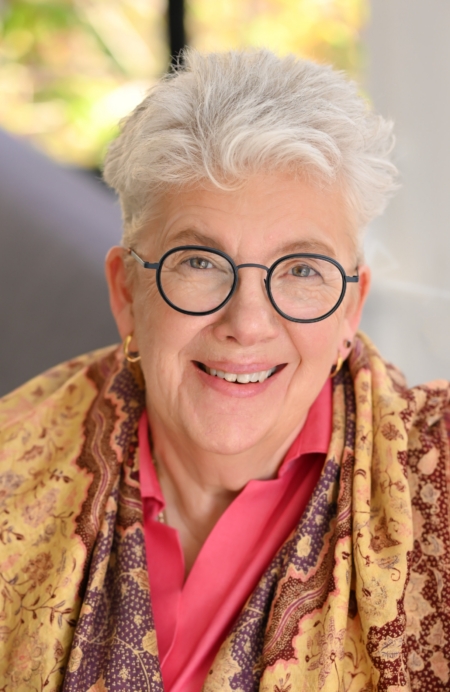
Milla is grateful for a meandering life journey in which the call has always been to see more widely, experience more deeply, and to weave together the spiritual impulse and the daily demands of work and life. Encountering Cynthia Bourgeault’s teaching while studying ecopsychology and integral theory in Colorado felt like a homecoming for Milla, and it continues to enrich and challenge her. Milla is a member of the TCS Board of Directors. She brings years of experience as a team leader, coach, and facilitator in social development efforts in the USA and Africa. She has a passion for poetry and the simple joys of long walks and baking good bread. Milla lives with her wife, Elizabeth, and two cats in Oregon, and enjoys being Ouma.
E-mail Milla at: admin@contemplative.org


Comments