
The Great Easter Invitation
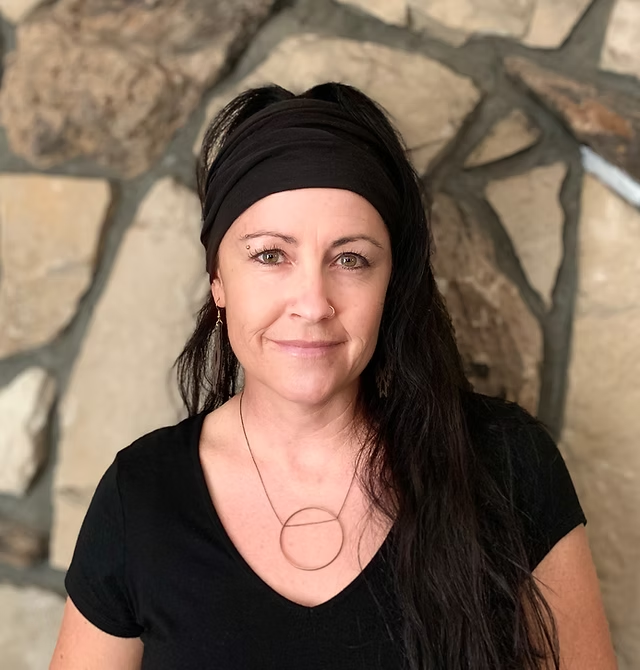
By Heather Ruce

Here we stand in the midst of Holy Week.
As we recollect the events that unfolded, we begin to sense that they are not only sacred stories, but living patterns that continue to reverberate within us and around us now.
Holy Week begins with celebration. A road covered with palm branches. A king entering the city.
On the surface, all appears well.
Yeshua (Jesus’s name in Hebrew/Aramaic) is hailed as king. His students must have felt a kind of relief, perhaps even vindication, that he was finally receiving the recognition they believed he deserved. And yet, Yeshua knew something they did not yet understand: he was not meant to be a ruler in the earthly realm (called World 48 in the Ray of Creation). The kingdom he embodied was of another world, what Cynthia Bourgeault has titled the Imaginal realm (also called World 24), which operates according to different laws.
He had been trying to show them all along that the Kingdom of God (World 24), the realm in which he lived and moved, was within them and among them. That this realm required a different organ of perception, a different inner platform from which to see and respond.
He also knew that the laws of the kingdom of the World 48 would inevitably come into conflict with the laws of the realm of God, and that this conflict would lead to his death. He saw that the people hailing his arrival down the palm-covered path would soon be the ones nailing him to a wooden cross.
When Things Begin to Fall Apart
As the week unfolds, what once appeared promising to his students, begins to unravel. Yeshua fell from public grace to being on trial before authorities with an accusation of blasphemy. Though he is seeing the lawful unfolding of circumstances according to World 24, from a world 48 vantage point it appears that things are not going well. They are falling apart. And this is where something essential is revealed, not only about them, but about us.
We begin to see the different ways his students, and all human beings, respond when reality does not go according to our expectations… when what we love appears to be threatened… when something or someone is dying.
Our typical reflexes reflect the egoic operating system, the necessary structure or sense of selfhood for navigating World 48. In the language of the Law of Three, this system organizes experience into opposing forces—an affirming force and a denying force—and from it we feel compelled to align with one or the other. This system also operates by the protective patterns of fight, flight, freeze, and fawn and while there is nothing inherently wrong with these patterns that tend to keep us alive, they are most oriented around what Thomas Keating has called our emotional programs for happiness. That is, the pursuit of power and control, safety and security, affection and esteem, all in an attempt to stabilize a world in which these resources are experienced as scarce. When we go on autopilot in this egoic operating system, functioning by way of these unconscious motivations, we forget ourselves and begin operating in ways that are false or incongruent (the self of World 96).
When we return to seeing how Yeshua’s students dealt with what was taking place, we see that Judas’ actions go along with the affirming forces moving against Jesus. In order to protect himself, he aligns himself with the momentum already underway. Peter, in contrast, first goes against what is happening. He reacts with a denying force, anger, and defense—cutting off the ear of the soldier in the garden. And then, when fear takes over, he turns to deception, denying that he even knows Jesus, to avoid conflict and maintain safety.
In Judas and Peter, we see the expected reactions of people who are operating from world 48 with the full spectrum of fight, flight, freeze, and fawn, as well as the programs for happiness at work attempting to stabilize a world that is slipping out of their grasp.
A Sacred Alternative
And then there are the three Marys: Mary Magdalene, Mary of Clopas, and Jesus’ mother Mary. These women reveal a different way of being in the midst of unraveling. We see Mary Magdalene at the beginning of these events, anointing Jesus as an act of profound love, humility, and recognition, covering him with a healing balm to assist him through what he is about to endure. We see all three Marys remaining present through all of the events that transpire: they are there at the arrest, at the crucifixion, at the tomb. It is to Mary Magdalene that Christ first appears after the resurrection.
They do not go with what is happening. They do not go against it.
They accompany.
They remain.
They bear witness.
They grieve.
They love.
The encircle.
They stand in a presence that does not collapse into reaction and in doing so, they participate in the conditions that make resurrection possible.
In the language of the Law of Three, they embody a reconciling third force—a spacious and sturdy inner posture that can allow the tension between what is dying and what has not yet come into form without choosing a side. They are, in a very real sense, midwives or doulas of both what is dying and what is being birthed, tending the threshold with courage, humility, and love.
Their example brings us to a living question: When we find ourselves in moments of personal or collective unraveling, how do we respond? Do we move against what is happening, trying to control, fix, or resist it? Do we move with it, collapsing into fear, adaptation, or self-protection? Or can we become spacious enough to remain present to what is?
Can we, like the Marys, hold a posture of loving attention in the midst of what is dying? Not passive. Not indifferent. But deeply engaged in a different way.
These questions are not abstract. We are living in a time in which many personal and collective structures are breaking down and unravelling. Circumstances are most likely not unfolding according to expectations we may or may not have known we have. What we hold most dear may feel threatened. Death, in many forms, is present. The question is not whether things are falling apart, it is whether we can remain present enough to midwife what is dying and what is being born.
Our Post: To Encircle What Is Breaking
These three students of Jesus show us the way.
We are not asked to create resurrection. We are asked to steward the conditions in which it can appear.
Perhaps this week, we might gently practice calling on the presence of the Marys, our spiritual ancestors, who have walked this path before us, allowing ourselves to be inwardly encircled and supported by them. Perhaps we can begin to notice where we are pulled to go with or against some of the forces within and around us, and to experiment with simply remaining present, open, and available. And where possible, becoming the ones who encircle a situation, a person, or a moment in quiet, conscious presence, trusting that something new is being formed, even if we cannot yet see it.
Not only to be encircled but to become those who encircle. Not to stop what is happening, nor to accelerate it, but to hold it within a field of conscious presence.
To accompany. To witness. To love.
Encircled by the Sacred Three
There are ancient Celtic encircling prayers that speak to this reality. Prayers we might draw on now. I invite you to pause and call on the company of these three sacred women. Let yourself receive them as living ancestors in the lineage of awakened presence, acknowledging them through the inward prayer:
My Fortress
The Sacred Three
My fortress be
Encircling me Come and be round My hearth and my home.
Or
The Mighty Three
Our protection be
Encircling us
You are around
Our life, this earthly home
Encircling us
O sacred Three
The Mighty Three
Perhaps we might open ourselves to the support of the three Marys in this way… those who have shown us how to remain, how to love when things fall apart, and how to stand at the threshold without turning away.
Sacred Three, teach us to encircle what is breaking and in doing so, midwife both what is dying and what is being born.
With love, Heather

Heather Ruce, MA, is a Wisdom spiritual director companioning individuals and facilitating practice circles, groups, retreats, and Wisdom schools focused on learning and living the Christian Wisdom Tradition. She integrates contemplation and embodiment through Centering Prayer, Christian meditation, sacred chanting, lectio divina, and sacred gestures in the service of waking up and putting on the Mind of Christ. Heather’s formation has been shaped by teachers, including Cynthia Bourgeault in the Christian Wisdom Tradition, Deborah Rose Longo in sacred movement, and Steve Hoskinson in trauma healing and complexity science through Organic Intelligence.
More on Heather Ruce: https://www.heatherruce.com/


Thank you for this beautiful and powerful offering, Heather.