
An Introduction to Teilhard de Chardin's Mass on the World

Updated: Mar 4

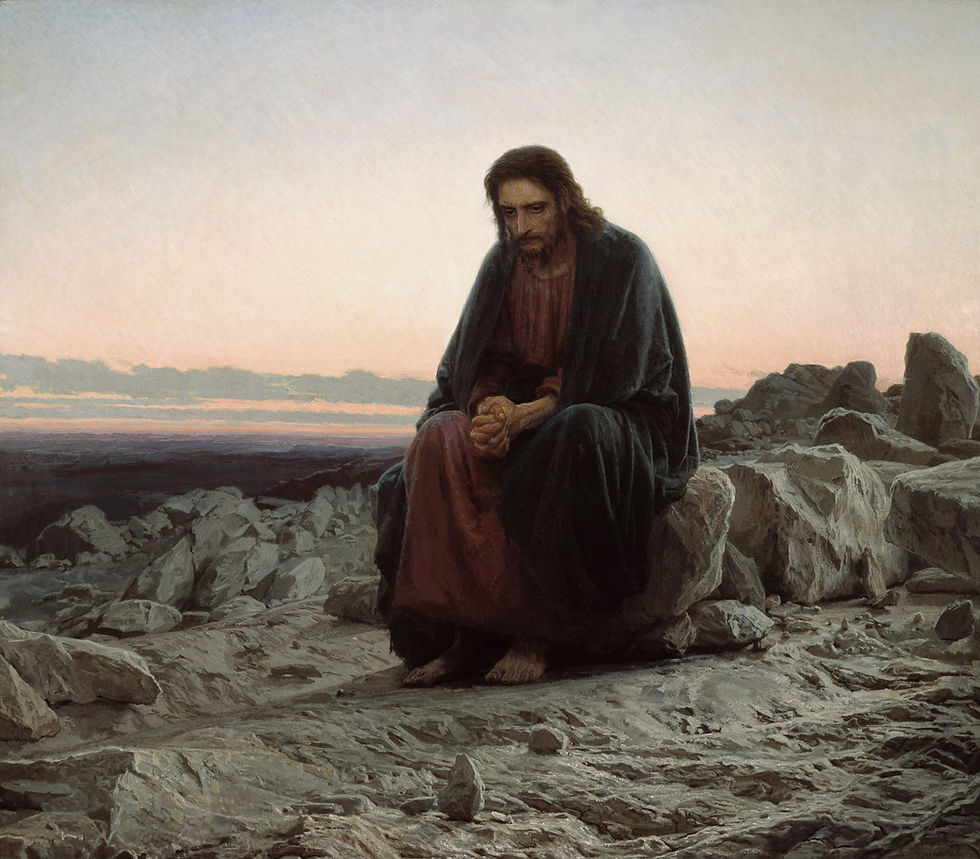
What happens when you want to offer Mass but have no bread, no wine, and no altar?
This was the reality for Pierre Teilhard de Chardin (1881–1955), the Jesuit priest and paleontologist, during a scientific expedition in the Gobi Desert. Lacking the elements for the Eucharist, he realized that the world itself (its work, its suffering, its evolution), could be his offering. He composed The Mass on the World, a profound prayer of cosmic offering.
Our founding teacher, Cynthia Bourgeault, has adapted the "Offertory" section of this text into a liturgical version for groups. It is a powerful way to consecrate the world’s labour and suffering to God.
A Brief Introduction
The Mass on the World is one of the 20th century’s most striking pieces of mystical literature, born not in a cathedral, but in the harsh, windswept ravines of the Ordos Desert in China. In 1923, Jesuit priest and paleontologist Pierre Teilhard de Chardin found himself on a scientific expedition without bread, wine, or altar. Unable to celebrate the Eucharist, he did not despair; instead, he expanded his understanding of the sacrament to include the entire cosmos.
Teilhard realized that if Christ is truly the "Logos" through whom all things were made, then the whole earth is sacred ground. In this liturgy, he lifts up the "world’s travail"—the wearying labour of scientific research, the struggle for truth, and the sheer physical evolution of the planet—as the raw material for offering. He saw the Eucharist not just as a ritual for the church, but as the "blazing center" of the universe, where all matter is slowly being transformed into spirit.
For modern contemplatives, this liturgy offers a profound way to bridge the gap between our spiritual lives and our daily work. It reminds us that our "chalice" is not empty; it is filled with the joys, sufferings, and striving of the human family. When we pray this Mass, we join Teilhard in asserting that everything, from the smallest atom to the furthest star, is converging toward a final unity in Divine Love.
How to Lead This Liturgy
Format: Group Circle
Time Needed: 15–20 minutes
Materials: Download the PDF Script Here
Video Example:
Preparation
Seating: Participants sit in a circle.
Readers: Choose two readers. They can sit opposite each other in the circle or stand at a lectern.
Music: Soft background music is recommended to hold the space. Cynthia Bourgeault strongly recommends “Essence” by Peter Kater.
Script
Reader 1:
Since once again, Lord…I have neither bread, nor wine, nor altar, I will raise myself beyond these symbols, up to the pure majesty of the real itself; I, your priest, will make the whole world my altar and on it will offer you all the labours and sufferings of the world.
Over there, on the horizon, the sun has just touched with light the outermost fringe of the eastern sky. Once again, beneath this moving sheet of fire, the living surface of the earth wakes and, once again, begins its fearful travail. I will place on my paten, O God, the harvest to be won by this renewal of labor. Into my chalice I shall pour all the sap which is to be pressed out this day from the earth’s fruits.
My chalice and my paten are the depths of a soul laid widely open to all the forces which in a moment will rise up from every corner of the earth and converge upon the Spirit. Grant me the remembrance and the mystic presence of all those whom the light is now awakening to a new day.
Reader 2:
One by one, Lord, I see and I love all those whom you have given me to sustain and charm my life. One by one, I also number those who make up that other beloved family which has gradually surrounded me, its unity fashioned out of the most disparate elements, with affinities of the heart, of scientific research, and of thought. And one by one—more vaguely, it is true, yet all-inclusively—I call before me the whole vast anonymous army of living humanity; those who surround me and support me though I do not know them; those who come and those who go; above all, those who in office, laboratory, and factory, through their vision of truth or despite their error, truly believe in the progress of earthly reality and who today will again take up their impassioned pursuit of the light.
This restless multitude, confused or orderly, the immensity of which terrifies us; this ocean of humanity whose slow, monotonous wave-flows trouble the hearts of even those whose faith is most firm; it is to his deep that I thus desire all the fibres of my being should respond. All the things in the world to which this day will bring increase; all those that will diminish; all those, too, that will die: all of them, Lord, I try to gather into my arms to hold them out to you in offering. This is the material of my sacrifice, the only material you desire.
Reader 1:
Once upon a time, men took into your temple the first fruits of their harvest, the flower of their flocks. But the offering you really want, the offering you mysteriously need each day to appease your hunger, to slake your thirst, is nothing less than the growth of the world borne ever onward in the stream of universal becoming.
(Reader 1 gestures participants to stand and raise their arms in a mutual oblation.)
Receive, O Lord, this all-embracing host which your whole creation, moved by your magnetism, offers you at this dawn of a new day.
(All in the circle hold the gesture for at least one or two minutes, as long as the energy can be sustained. Then, as Reader 1 lowers their arms, inviting those in the circle to do likewise, Reader 2 begins to speak.)
Reader 2:
This bread, our toil, is of itself, I know, but an immense fragmentation; this wine, our pain, is no more, I know, than a draught that dissolves. Yet in the very depths of this formless mass you have implanted—and this I am sure of, for I sense it—a desire, irresistible, hallowing, which makes us cry out, believer and unbeliever alike, “Lord, make us one.”
Reader 1:
“Lord, make us one…..”
(Readers encourage others in the circle to join in this spoken petition. When words subside, turn down the music, and readers again sit, inviting participants to do likewise. Liturgy then moves into silent meditation for at least five or ten more minutes.)
Living the Mass on the World
Ultimately, Teilhard’s Mass on the World is more than just a beautiful text; it is a radical reframing of the Christian life. It challenges the persistent illusion that there is a divide between the "sacred" work of the church and the "secular" work of the world.
By praying this liturgy, we step into a "cosmic priesthood." We remind ourselves that our daily labour (whether in a boardroom, a garden, or a kitchen) is not a distraction from God, but the very "wheat and grapes" required for the transformation of the world. As Teilhard realized, the world itself is a giant host, slowly being transformed by the fire of Divine Love.
We invite you to use this liturgy whenever you feel disconnected from the sacredness of your own life. May it remind you that you are always standing at the altar of the earth, and that your life is the only material God desires.
*Curated by Nicholas Fournie, Communications Coordinator, The Contemplative Society

PO Box 23031, Cook St. RPO
Victoria, British Columbia
Canada, V8V 4Z8
Copyright © 2025 - The Contemplative Society. All rights reserved.

Comments