
The Zen of Boston Driving

Updated: Feb 23
Tools for Carrying the Burdens of a Hostile World.
By Paula Pryce

Part Two:
Intentional Suffering
Traffic in Boston is mythic. People racing, gesticulating, and jockeying in whatever way possible. Rules are optional, it seems, and civility? Well – I’ve often thought Boston traffic to be the perfect microcosm of the get-ahead society.
Here are a few of the images seared into my mind:
A father with a carload of toddlers drives onto the sidewalk to jump the queue and gives the finger to anyone who dares honk.
A prim grandmotherly type tosses her head, flaps her arms, and swears like a sailor, spoiling for a fight over a fender bender that she herself caused.
A smartly dressed professional leans out the window of his BMW to yell at a woman trying to cross the street with two small children, “You f**kin’ mothers think you own the road!”
Not a pretty sight. Thrashing alligators are the dark side of communities that honour above all else ingenuity and brilliance in the individual. Helen Keller and Annie Sullivan, Elie Wiesel, Leonard Bernstein, Isabella Stewart Gardner, Martin Luther King Jr., Noam Chomsky, Elizabeth Warren, Jon Kabat-Zinn, Yo-Yo Ma, and any number of Nobel Prize laureates . . . they and scores of other innovators have flourished under the Boston banner of individual heroism. The city has supported its stars like no other place.
But what about everyone else? Few play a cello like Yo-Yo Ma. If you aren’t at the apex of humanity, there’s no soft landing and the anxiety seeps out in all kinds of places. People who kindly greet their neighbours over the fence regularly succumb to fight-for-your-life competitiveness in the bubble of their cars. Yes, Boston driving culture used to upset me in the years I lived there – especially when I realized my growing inclination to gesticulate and swear like everyone else.
The stresses of Boston drivers may not be an earth-shattering kind of suffering, but it is nevertheless real. Aggressors or the recipients of aggression, privileged or impoverished, every one of us suffers. Granted, illustrating the universality of suffering with an everyday annoyance like bad traffic likely seems misguided in the complex upheavals of our times. We are all aware how the social wheels of power turn to favour the few and leave others to poverty, imprisonment, violence, and oppression.
Yet, little things are a substantial part, even the primary source, of suffering for many of us. Waiting on a colleague’s late report or facing a stack of dishes standing between you and your hike are sometimes the most dispiriting things we deal with in day-to-day life. So ubiquitous and so ordinary that, in our irritation, we forget that the Divine really is in our midst, and that every banal or exasperating moment offers the possibility to suffuse the world with compassion.
The stagnant grocery line or a string of stoplights is as good as anywhere to choose sanctity.

That something is everywhere and always amiss is part of the very stuff of creation.– Annie Dillard
There’s no denying that suffering is an existential part of our world. Not a judgement, not a retribution. Just part of life. In The Wisdom Jesus, Cynthia Bourgeault says that a recognition of the fundamental presence of pain dawned on her only when she read Annie Dillard’s Pilgrim at Tinker Creek. Cynthia pondered “the jagged, binary nature of this realm of existence, a reality attested to by all the great spiritual traditions” and concluded that only in the “particular density” of earth’s “sharp edges and term limits . . . do the conditions become perfect for the expression of the most tender and vulnerable aspects of divine love.” In other words, the “irreducible brokenness” in which we dwell gives us the seeds that can transform the world.
Jungian psychologist Helen Luke notes that we use the word suffering in two distinct ways. Suffering can describe things that weigh us down, such as affliction (from fligere – “to strike”) and grief (gravare – that which is grave), or it can refer to something almost opposite in meaning: to hold up or support. The word suffering derives from the Latin root, ferre, meaning “to bear.” Add the word’s prefix, sub (“under”), and we come up with something like “carrying from beneath” or “undercarriage.” Kind of like the chassis of a vehicle – a car, a train, a wagon – that bears a load to its destination.
Helen Luke’s view of suffering as undercarriage encourages us to reconsider our compulsion to avoid pain and seek pleasure. By setting aside our urge to fly, deny, or collapse in the presence of adversity and instead consciously accept the reality of pain, we can begin to assist in subduing its effects.
Cynthia Bourgeault would call this intentional suffering. Introduced in the works of G.I. Gurdjieff, intentional suffering is an understandably confusing term that could easily be interpreted as seeking affliction on purpose. That, however, amounts to a martyr syndrome and a warped search for power. Intentional suffering instead describes how we can consciously address the pain that exists regardless of our fantasies of heroism. Our part begins with humility and a recognition that we have a choice to bear pain in the service of others. Cynthia writes in Eye of the Heart, “If conscious labor increases our capacity to stay present, intentional suffering radically increases the heartfulness of that presence.” Like conscious labour (the subject of my last TCS reflection), intentional suffering works against the entropic force that bleeds away energy fueling restorative care. Intentional suffering “invites us to step up to the plate and willingly carry a piece of universal suffering.”
Demanding lucidity and contemplative maturity, intentional suffering evokes Divine flow and thus alters sites of pain. “Close at hand the effects are immediately visible,” writes Helen Luke. “Those around us may know nothing of what is happening, but a weight is lifted from the atmosphere, or someone we love is set free to be herself, and the sufferer acquires a new clarity of vision and sensitivity.” Luke illustrates the difference between self-oriented and detached approaches to caring for others who suffer. If a nurse “reacts with intense personal emotion to the patient’s misery,” she writes, “she will either repress what she cannot bear and become hard and unfeeling, or else will increase the sick one’s burden through her unconscious identification.” A “true nurse,” on the other hand, carries the afflicted by attending them with compassion (“suffering with”), not emotional reactivity. Luke says, “The difference is subtle but absolutely distinct when experienced.”
Intentional suffering is more than a pragmatic diffusion of panic or misery. At its best, “sitting with the beast,” as Cynthia Bourgeault has called it, is an incarnational intercessory prayer. Intentional suffering invites the Divine to make her presence known where people experience anguish and sorrow.
Yes, but how? How do we enter into the prayer of making things better, not worse?
The practice of intentional suffering requires that we let go of our agendas, steer clear of self-interest, and open ourselves to God. “There’s no ‘you’ in it, no story, no drama, no ‘I’,” Cynthia once said at a Wisdom School when explaining our role in intercessory forms of prayer. In the practice of intentional suffering, one must have a “deadpan compassionate calm almost unknown in Christianity” that willingly participates in “a cycle that is bigger and more ancient than you,” she said. We need to let go of all the noise and simply consent to the Divine.
Humility and a surrendered heart are essential, but the actual methods can vary. Tonglen – the Buddhist practice of breathing in the pain of the world and breathing out peace – is an obvious way to carry suffering on behalf of others. Another is statio, an ancient Christian practice first introduced to me by the monks of the Society of Saint John the Evangelist in Cambridge, across the river from Boston.
Statio is the classic monastic practice of stopping, reflecting, and reorienting oneself toward the Divine. In monasteries, there is often an architectural space designated especially for the prayer of stopping. A small vestibule called the statio (what else?) links the sacristy, where monks and nuns do the work of preparing liturgies, to the sanctuary, where they chant, pray, and perform the Eucharist. The statio is a liminal space where monks and nuns stop and gather themselves before moving either to formal worship or to the tasks of ordinary life. It is a space that links the energy of the chapel to the larger world.
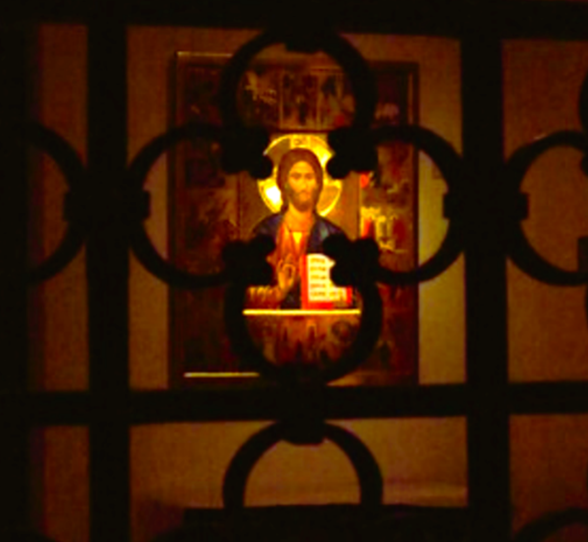
Keep attention in yourself, not on yourself
While the Welcoming Prayer may be the most familiar form of statio for Centering Prayer practitioners, the one I most often attempt comes from Cynthia Bourgeault’s teaching to “keep attention in yourself, not on yourself.” Tinkering over the years, I adapted this adage to a practice of energetic redirection. Have you noticed how much energy we expend when we are in the emotional whirlpool of our own stories? If I perceive myself engaged in the temperamental weather of daydreams and dilemmas (“keeping attention on yourself”), I turn to kenotic self-emptying. Stopping, stilling, and remembering helps me shift my attention from psychological hubbub to the physical sensation of the Divine gaze. I consent to God’s presence in the parameters of my body and the present moment by taking emotional energy – worry, anger, pride, even elation if it’s excessive – and recasting it as enlivened physical energy.
Redirecting the energy that already exists in one form (“on myself”) toward another form (“in myself”) opens the field so that paradoxically, the inward gaze catalyzes a receptivity to others’ pain. The shift from self-concern to conscious awareness gives freedom to serve others with less reactivity, less desire for personal gain, and less urgency to push in the direction of our own agenda. The practice of “in yourself, not on yourself” prompts us to deftly switch the energetic gaze from psychic rumination to embodied connectedness with the Divine. It cleanses the palette and resets the field so that our offers of service are less about ourselves and more about carrying the weight that others bear.

The Zen of Boston Driving
One evening after Evensong at the SSJE monastery, I stepped out beneath the leafy sycamores on Memorial Drive. Cars whizzed by, a harried boundary between me and the shore of the beautiful Charles River. My heart sank. Yet again, I was to face the demons of another rush-hour commute home.
But that day I reflected on what I had learned from the monks, Cynthia, and other teachers I’d been following while living in New England. Then and there I decided to make Boston driving a contemplative experiment. My primary intention was to not get upset with other drivers. I needed to drive responsively to people who didn’t follow the rules, but I didn’t need to get emotional about it. Instead, I promised myself that when something unexpected happened, I would persist in stopping, noticing, and redirecting any ricochetting emotion to an awareness of the Divine at the centre and let that energy flow to the people around me.
Committing to this practice over the weeks, I found that the daily drive through rush hour became almost like a dance with other drivers. I felt I was part of an active but seamless flow in a river of cars. Coherent, receptive, even joyful. Later I joked with some Wisdom School participants that I would write an Op/Ed piece for The Boston Globe called “The Zen of Boston Driving.” Zen, of course, is not exactly what people think of when they get into a car in Boston, and yet there I encountered a universe of possibility by willingly entering a tiny corner of the suffering world. Rather than abandoning myself to anger or ratcheting up pain and anxiety, I committed to making things better, not worse. Driving in Boston, like anything else, can become a mode of healing prayer.
Cynthia Bourgeault considers intentional suffering a “high practice,” one that demands nerve, experience, and a firm commitment regardless of conditions. If we refine the practice of “fiercer suffering,” Helen Luke tells us that “a strange thing may happen. We [lift] the weight and, instead of being crushed by it, we find it is extraordinarily light.” Such work neither gives the fragile hit of the martyr complex nor the thin veneer of frantic pleasure. Serving others with detachment and compassion instead bestows true joy, one that can help change the world right where we are.
An ancient Christian symbol for the Incarnation is the four-wheeled chariot. Helen Luke made that symbolic connection when she started thinking about suffering as a kind of undercarriage. It turns out that we don’t have to be Yo-Yo Ma or Helen Keller or Jon Kabat-Zinn to help transform the hurly burly of a suffering world. Like Elijah rising to heaven in his chariot of fire, we simply have to get off the curb and open the door.

This reflection draws from Cynthia Bourgeault’s The Wisdom Jesus (Shambala, 2008) and Eye of the Heart (Shambala, 2020), Helen M. Luke’s Old Age (Morning Light, 1987), and my own book, The Monk’s Cell: Ritual and Knowledge in American Contemplative Christianity (Oxford, 2018). See especially chapter three of Eye of the Heart, chapters 10 and 15 of The Wisdom Jesus, and the essay “Suffering” in Old Age.
Paula Pryce writes reflections for The Contemplative Society every other month. She is a cultural anthropologist and writer who specializes in ritual studies and contemplative religions. Her publications include The Monk’s Cell: Ritual and Knowledge in American Contemplative Christianity.
To connect with Paula about this reflection, please e-mail TCS at admin@contemplative.org. Your e-mails will be forwarded onto her.
The Contemplative Society (TCS) offers our heartfelt gratitude and appreciation for The Divine gift to humanity that is Paula Pryce. TCS’s community is blessed to have Paula offer of herself to us through her wise reflections.

Comments