
The Monk’s Cell: Ritual and Knowledge in American Contemplative Christianity


Please Note: This article has been condensed from 8 original parts, published on the Contemplative Society's blog between March 4th 2019 and July 2nd 2019.
Skip to the section you are looking for:
Part 1
This 8-part blog offers excerpts from my book, The Monk’s Cell: Ritual and Knowledge in American Contemplative Christianity (Oxford University Press, 2018).

To begin, let me introduce myself: my anthropological research has been shaped by childhood experiences among interreligious contemplatives, particularly my Anglo-Indian father. An early exposure to meditation prompted me to seek deeper knowledge about the extraordinary power of the human capacity for connectedness with the divine and one another. The Monk’s Cell is the result of four years of ethnographic research I did in the Wisdom community, American monasteries, and overseas pilgrimages, where I listened closely for the nuances of the experiential communion that rises through contemplative practices. My intention was to bring a complex depiction of this world to those who do not understand it, especially working to get past academics’ divisive framing of religion as non-rational. Many thanks again to Cynthia Bourgeault and all who have welcomed me into their midst during this research, and also to friends at The Contemplative Society for inviting me to make this contribution.
The Monk’s Cell’s chapters are modeled on an architectural metaphor for “deepening into the divine,” similar to Teresa of Ávila’s Interior Castle. The first chapter, Portico, describes how longing for the divine draws people to contemplative Christianity.
Excerpts from The Monk’s Cell Chapter 1:
Portico
Finding a Way to the Door of American Contemplative Christianity
My inner heart was yearning desperately for something I could not name, a space for falling in love . . . I simply knew that the God of my heart was calling me deeper and deeper into silence and solitude. My Beloved was yearning for me . . . and so I sat and listened. As St. Benedict names it, I listened “with the ear of my heart.” . . . I knew I had to go.— Brigid’s e-journal
Eros and the Call for Intimacy with the Divine
. . . The wall between self and God can become extraordinarily permeable for contemplative Christian practitioners as they work toward an experiential, non-objectified understanding of the divine arising from the “mutuality of desire” between themselves and God . . .
We see their yearning in St. Anthony, the fourth-century Egyptian desert hermit who lived in extreme asceticism, staving off all desire except a passion for God, in the monk St. John Climacus’s seventh-century depiction of divine love as “an abyss of illumination, a fountain of fire, bubbling up to inflame the thirsty soul,” in St. Hildegard von Bingen’s twelfth-century experience of “a fiery light of the greatest brilliancy coming from the opened heavens . . . [which] kindled in my heart and my breast a flame” and in her contemporary, St. Bernard of Clairvaux’s eager search for the “spiritual kiss of Christ’s mouth,” in St. Catherine of Siena’s fourteenth-century visions of her mystical marriage to Jesus, and in the Jesuit priest Teilhard de Chardin’s twentieth-century confession that in his pursuit of the physical sciences and evolutionary theory, including the discovery of Peking Man, he sought Christ and “saw, as though in an ecstasy, that through all nature I was immersed in God.” So, too, the thirst for intimacy with God arose in Brigid’s e-journal, written in the American Midwest in the twenty-first century especially for this research. Together these writings reveal how eros for the divine has had an enduring place in the history of Christianity. Such desire continues to work through the impulses and actions of contemplative Christians today.
For those who are interested in purchasing a copy of The Monk’s Cell, you can receive a 30% discount by ordering online at global.oup.com/academic with promotion code AAFLYG6.
Part 2
Excerpts from The Monk’s Cell Chapter 2: Antechapel

Antechapel
Gathering and Grounding Contemplative Christians in a Pluralistic Society
Continuing with the series of excerpts from The Monk’s Cell: Ritual and Knowledge in American Contemplative Christianity (Oxford University Press, 2018), the second chapter, Antechapel, describes how monastic and non-monastic teachers convey contemplative principles, like detachment and humility, and offer tools, such as rules of life, to help stabilize their students’ intentions to follow alternative life ways.
A teacher in the American contemplative Christian movement, Br. Curtis Almquist of the Society of Saint John the Evangelist used the motifs of detachment and humility to get across the contemplative Christian ethos. Through them, he showed how the intentional cultivation of ambiguity and paradox can prompt people to see past their usual boundaries. In a public lecture about his monastery’s stained-glass windows, Br. Curtis described how the glass artist and the architect together created structural juxtapositions that fostered a feeling of liminality. Their work prompted those who entered the chapel to cross the limen (Latin for threshold) into another way of being. When one passes over the threshold, he said, one enters a “place of in-between” that brings together earthly and divine realms. This ambiguous place of “both/and” potentially acts as an “icon,” he said, a kind of window or conduit through which the human and the divine make contact.
Expanding on the notion that ambiguity and paradox have the transformative potential to take people beyond usual frames of knowledge and experience, Br. Curtis highlighted the chapel’s contrasting architectural qualities. The paradoxical union of weighty stone and weightless light, for example, simultaneously fostered stability and effervescence. He said,
“Nothing could be heavier than a floor of undressed slate and polished marble, and the serene walls of granite. No matter how much you may feel your life is adrift, when you come into this space, you are grounded . . . but then the limestone Gothic arches, columns, pillars, and capitals lift your gaze to the light of the heavens with the beautiful rose window that crowns the antechapel, and the clerestory windows that line the choir.”
The designers intentionally created an admixture of darkness and light in the chapel, which further expands a feeling of in-betweenness, unknowing, and wonder. Shadowy recesses contrasted with the danger of too much light, said Br. Curtis, the glare and exposure that he called “the wound of knowledge” after the words of Welsh poet, R.S. Thomas. Sanctification and holiness come through “an intermingling of light and darkness, enough of both.” The mystery of ambiguous “holy shadow” is as primary to awakening to the divine as the dazzle of overt knowledge.
Part 3
Excerpts from The Monk’s Cell Chapter 3: Grille

Grille
Silence and Seclusion: Contemplative Environments of Interiority and Receptivity
Continuing with the series of excerpts from The Monk’s Cell: Ritual and Knowledge in American Contemplative Christianity (Oxford University Press, 2018), the third chapter, Grille, describes the aesthetics of the silence and interiority that help foster a distinctive, intentional way of life, and how that silence paradoxically communicates hospitality, warmth, and community.
Varieties of Silence
3:30am – St. Benedict’s Monastery, Snowmass, Colorado:
Stepping into the frosty air, I gasped. The stars! At this altitude, in this cold, the stars really did have points, five crisp points just like a child’s drawing. Except for the faint starlight, the earth rested silent in deep moonless dark. Periodic flashes from my light helped me keep to the unplowed gravel road. The beams caught the hoary frost, glittering, almost magical, on the sagebrush, grasses, and fence posts.
Entering the austere Trappist chapel, then edging my way to a side bench up against the brick wall, I moved into another variety of silence. It was dark except for a few starry votives at the tabernacle and icons. The monks, in hooded, ivory-colored habits, sat motionless on wooden benches in the antechapel. Their quiet seemed to blossom through space. A “pungent silence,” our retreat leader, Cynthia Bourgeault, had called it on a previous visit. It had a kind of density, not accidental but filled with intention and potency.
With their initiation of the Vigil office, the monks approached the conclusion of that night’s Great Silence. A clock chimed from the cloister walk outside. The monks rose, then the cantor toned, “Lord, open our lips.” The community used their thumbs to make the sign of the cross over their mouths, then chanted in response, “That our mouth shall show forth thy praise.”
The plainsong seemed to greet the silence rather than diminish it. Their words were inward, muted, and perfectly synchronized; the unified sound emerged from them effortlessly. It was not beautiful in the way of a stunning, magnetic performance of an accomplished concert choir, but was arresting in its simplicity and ease and intercorporeality. Their sound inhabited the silence as from a single body.
After the office of Vigils and a lengthy period of meditation, I walked back to the guesthouse. The monks’ intentional silence and sound made the quietude of the valley seem even more apparent. I heard not the slightest rustle in the frozen grasses. These two hours later, the air was colder and the stars had shifted, some constellations having set, others risen. My eyes adjusted to find that the sky had just perceptibly lightened. I could make out the edges of snow banks along the gravel road and discerned the slightly darker mass of mountains against the retreating night. I stopped to listen to the extraordinary lack of sound.
Just then, a lonely call cast itself across the valley from a high ridge. An interlude. Moments later, yips, howls, and yaps came bounding from an opposite hillside. I laughed at their versicle and responsory, cantor and choir Rocky Mountain style. A shooting star burst across the night sky as if in silent appreciation of the coyotes’ early morning office.
Part 4
Excerpts from The Monk’s Cell Chapter 4: Gate

Gate
Stabilities, Innovations, Diversities
Continuing with the series of excerpts from The Monk’s Cell: Ritual and Knowledge in American Contemplative Christianity (Oxford University Press, 2018), the fourth chapter, Gate, describes the charismatic appeal of teachers and diversity within the American contemplative Christianity movement. Exploring the limits of variability in this dynamic, open-minded movement, the chapter compares the distinctive ethos – penitence and eros – of monastic and Wisdom rites for Holy Week.
Apparent in their liturgy for the Wednesday of Holy Week, Wisdom Christianity’s approach to the re-enactment of the events leading to Jesus’ death and resurrection differed significantly from the Society of Saint John the Evangelist’s more standard Tenebrae service. Both described the crucifixion of Jesus as “the Passion of Christ,” but the tones of that passion – eros and despair – had quite different connotations.
These differences were clear in distinct liturgical ‘bookends’ in each group’s rites. SSJE began Holy Week with a ritual diminishment of light in Wednesday’s Tenebrae, the Service of Shadows, and concluded it with increasing light at the Easter Vigil when, in pre-dawn darkness, the monks kindled the sacramental fire from which the great Paschal candle was lit. People then spread the flame from taper to taper until the chapel became a universe of stars. By the time the priest had proclaimed ‘Christ is risen!’ some hours later, every light in the chapel had been turned on and daylight of the newly risen sun streamed through the clerestory windows. The entire three-day Triduum was thus ritually bracketed with Wednesday’s light to darkness and the Easter Vigil’s darkness to light. The light and darkness symbolized the people’s journey through Holy Week as a passage of cosmic scale, in some way well beyond the imaginings and experience of ordinary human beings, despite the centrality of its very human story of betrayal and death.
While the Wisdom community also included this ancient ‘light out of darkness’ rite with the lighting of the sacred fire and Paschal candle at the Easter Vigil, Cynthia Bourgeault, Ward Bauman, and Darlene Franz emphasized another kind of ritual bookending. The Anointing Ceremony on Wednesday in Holy Week was paired with Easter morning’s gospel story of Mary Magdalene and another woman approaching the tomb to anoint Jesus’ body. These ritual brackets are not the meaningful yet impersonal cosmic symbols of light and darkness, but the personal and intimate actions of sacramental touch at the hand of a devoted disciple, ritualized as gestures of cosmic significance. Focusing on alternative historical references (the scriptural accounts of loyal women anointing Jesus as well as anointing rites in general), the Wisdom liturgists hoped to reframe the Easter story from one of abandonment and betrayal to one of stalwart, attentive, and fearless passion. By highlighting different historical passages and using standard liturgical elements like sacred drama, anointing, and chanting in alternative ways, Cynthia Bourgeault hoped to shift ‘the emotional epicenter of Holy Week from blame and guilt to freely offered transfiguring love.’
Thus, while American contemplative Christianity had strong unifying points, the movement also had internal diversity. With their ‘orthodox’ tone, monasteries had the advantage of implicit authenticity in the weighty imagery of a substantial historical lineage, despite the reality of periodic stability, rupture, and renewal that has brought contemporary monastic communities into being. More overtly innovative, Christian Wisdom teachers like Cynthia Bourgeault worked at the grassroots level to encourage their versions of history by writing books, teaching online, and offering workshops, retreats, and Wisdom Schools all over the United States and abroad. One long-time practitioner of contemplative Christianity in my research marveled at how their determined efforts, practical skill, and ‘phenomenal knowledge’ had ‘sown seeds all over the place to get the Wisdom network to grow and flourish.’”
Part 5
Excerpts from The Monk’s Cell Chapter 5: Choir

Choir
Silence––Stillness—Movement—Sound:
Ritual, Attention, and Refinement of the Senses
This is the fifth post from an 8-week cycle drawing excerpts from my book, The Monk’s Cell: Ritual and Knowledge in American Contemplative Christianity (Oxford University Press, 2018). Chapters five, six, and seven work together as a kind of Triduum (the three-day rite of Easter, beginning with Maundy Thursday, following with Good Friday, and concluding with the Easter Vigil). They together describe the relationship of formal ritual, conscious work, and knowledge (especially the phenomenon of interconnectedness that contemplatives call “unitive being”). The fifth chapter, Choir, looks particularly at the ora of Benedictine ora et labora: how contemplative Christianity uses cycles of formal ritual – silence, stillness, movement, sound – to hone attention and contemplative senses.
Keenly aware that scripture describes the human body itself as a temple and sacred space, Christian contemplatives with whom I worked considered ritual practices and attunement exercises to be ways of establishing and sharpening their capacity to perceive divine presence through the senses. People engaged in formal ritual and the ritualization of everyday life in an effort to become more aware of an immanent divine in both their individual bodies and the collective body, that is, the practicing, observant community that the apostle Paul called ‘The Body of Christ.’ In contemplative Christianity, the idea of incarnation and the development of contemplative senses thus underlay the importance of formal practice and aesthetics at the sites of ritual action. Chapel, person, and community were symbolically and phenomenologically linked.
Under the sheltering solidity of stone arches, the choir became a vessel that stirred contemplative senses by marking the shifting tone of liturgical seasons and by giving form to the ephemeral in sound, gestures, and objects. It was the place where monks created a ground of silence into which they sowed chant and spoken word. The choir offered the pungent aroma of frankincense, rising high in paisley helixes from simple bronze dishes, or in voluptuous billows from ornate silver censers as a priest blessed the altar for the Eucharist. It was the place where one felt the shock of cold on face and hands when the Abbot made the rounds of the choir stalls at the end of Compline, showering the people with holy water, and where sharp wine helped dissolve a crumbly, sweet, oversized piece of unleavened bread. There in the choir, shifting medallions of color cast down from stained-glass windows to a checkerboard marble floor, and a monk’s warm touch combined with cool, slick oil or gritty soot as he placed the sign of the cross on people’s foreheads; candles, few or many, towered on the altar in silver, laid low on the floor in ceramic, flickered in jewel-toned glass high on granite ledges, or moved like a river of light in the hands of processing congregants. There one also felt the weighty Daily Office book, held in both hands and braced against torso, or set upon the smooth oak of a well-worn choir desk. Flowers added notes of color and scent: a handful of mauve lilacs at the statue of Mary in Ordinary Time, bowers of red peonies at the choir’s center at Pentecost, or nothing, only their absence, in the depths of Lent. Add to this aesthetic world the sometimes wrenching physical effort of waking at dawn or earlier, then sitting, standing, bowing, and kneeling with the community’s ceaseless tide of liturgy, ever moving regardless of one’s energy, lethargy, engagement, or indifference.
Part 6
Excerpts from The Monk’s Cell Chapter 6: Sacristy

Sacristy
Prayer without Ceasing: The Ritualization of Everyday Life
Continuing with the series of excerpts from The Monk’s Cell: Ritual and Knowledge in American Contemplative Christianity (Oxford University Press, 2018), the sixth chapter, Sacristy, looks at how contemplative Christians use conscious work – the labora of Benedictine ora et labora – to cultivate contemplative attentiveness in all aspects of life.
At the House of Prayer Wisdom School in August 2011, Brigid had learned her lessons on keeping attention particularly well. Teachers and students alike recognized her as having an unusual capacity to employ ritualized postures as a way of attuning herself to the ambiguous flow of the divine. After a long day of silent meditation, liturgies, sohbet seminars, and work periods, Brigid sat a little off to the side of the Common Room’s haphazard circle of chairs and sofas during the evening discussion period. A small woman in her forties, Brigid was soft-spoken and gave the impression of being shy. However, when she found an opening in the conversation to convey her experience of kitchen duty, she spoke so deliberately and with such focus that the whole room listened with uniform stillness. Brigid compelled the attention of others by carefully selecting each word, unafraid of lengthy pauses as she sought the right way to relay her observations. There appeared to be a concentration of meaning in each precise word, as though she were reliving the moments she had experienced earlier in the day. Her way of speaking itself seemed to be an act of attention and staying present.
Brigid told us that she had been assigned to kitchen duty for the week’s experimental work periods. That morning Ward Bauman, the retreat house director, had asked her to chop vegetables for a dish to be served at the evening meal. Brigid described the cucumber, the wood grain of the cutting board, the weight and feel of the cleaver, the pressure of hand against knife and the positioning of fingers; she described the intensity of the cucumber’s colors meeting in concentric circles of deep green skin, near-white inner flesh, and translucent innermost seeds: how the blade bit through resisting skin, then sank through the firm but giving inner flesh, its varied densities and leniencies. “Not the green or the white,” she said pausing again and visibly shaking now, eyes bright with the immediacy of her recollection, “but in their meeting place – where they came together – was their place of surrender.”
Brigid sat silently for a few moments but had something more to add. Because of the noisy kitchen bustle at the beginning of the work period, she had been unable to hear exactly how Ward wanted the cucumber to be sliced. Ward had passed by her side-counter station in the middle of the work period, had taken a quick look, and said, “Smaller.” But Brigid had not wanted to cut the pieces smaller. She said, “I’d cut these perfect circles and stacked them three pieces high in perfectly aligned rows at the edge of the cutting board.” Recalling a Sufi poem that praised seeds at the center, she had resisted Ward’s request to cut through the seed circle. Yet Brigid had sliced into them anyway, letting go of the desire to preserve a form that had meaning for her.
As she cut, her board had become wet with cucumber juice and the slices wouldn’t stay put. “The cucumbers were slippery and the pieces went everywhere!” she said. In the midst of ineffectually trying to corral them, she had stopped with sudden realization: “Abundance!” exclaimed Brigid, “a gravitational outpouring of abundance everywhere around us!” She then returned to her measured, concentrated way, saying, “I could see the beauty in the cucumber, but if I had kept to what I knew and what I thought I wanted, I would not have understood the abundance.”
No one made a sound. All motion seemed to have been arrested by the intensity with which Brigid had conveyed her experiments with intentional kitchen work. The way she spoke and the intensity of her listeners’ focus together profoundly changed the atmosphere of the room. Brigid’s ritualized act of deliberate speech seemed to offer a glimpse of the divine that bound the community, even more than the details of her observations. The air itself seemed to shimmer. After a while, Cynthia said in almost a whisper, “Someone’s paying attention, wow.” Helen then glanced over to me and quietly said, “Our very own T.S. Eliot.”
Part 7
Excerpts from The Monk’s Cell Chapter 7:

Sanctuary
The Person as Icon: American Contemplative Christian Ways of Knowing
Continuing with the series of excerpts from The Monk’s Cell: Ritual and Knowledge in American Contemplative Christianity (Oxford University Press, 2018), the seventh chapter, Sanctuary, looks at the dynamics of unitive being, the intersubjective knowledge that rises from training in intentionality and attentiveness through formal ritual and conscious labour. Using the example of Wisdom Schools and Gurdjieff’s Movements, the chapter also describes how certain individuals and groups develop a capacity to act as icons, that is, conduits of the divine for the greater community.
Transfiguration of the Turkey Carcass:
In the West Virginia Wisdom School in November 2013, Cynthia Bourgeault had set tasks about paying attention to sensations in the body, like identifying and using only the muscles necessary for particular work. She also layered in questions about the relationship of attention and prayer. She qualified her instructions with the comment, “if it interests you,” thus emphasizing the central role of individual will and personal responsibility in undertaking the work with seriousness. Prompted by these tasks and questions, I began experimenting with ridding myself of extraneous sound and movement as a practical way to hone attention. This manifested as a simplification of movement and sound, not as dilution, but rather its opposite: a concentration of movement and sound that inspired feelings of increasing energy in my body. This conscious action resulted in sensations of a densification of energy that nevertheless felt spacious, light, and expansive. I sensed a fluidity and connectedness in my movements, which made them feel as though they extended out past the boundaries of my physical body, connecting with other entities, including other Wisdom School participants. This variety of attention had the sensation of radiating outward, while simultaneously feeling receptive of energies coming from other sources. If I consciously kept attention and presence, these sensations not only continued through any activity I was doing— washing windows, performing Movements, listening or speaking at seminars, eating meals— but also seemed to build in intensity.
By Thursday evening, when I was on clean-up duty after an excellent Thanksgiving dinner that the residential community had prepared for us, I could not only feel “energy” but could actually see colour and light shimmering around me. As I removed a serving platter from the buffet table, the turkey carcass was vivified with heightened, bouncing colour; strong tingling sensations coursed up my arms and into my chest and torso, seeming to pass back and forth between me and the remains of the bird. I also felt vibrations in my lips and forehead, down my arms to the palms of my hands, through my torso, and down my legs to the soles of my feet and past them. These sensations felt like being on fire with energy, creative potential, and alertness, and seemed to extend past turkey carcass into the space beyond, like an expansion of self into the world, a physical connectedness that was simultaneously emanating and receptive. It was as though my body had become porous to other entities and, as one person in my research had said, it almost had a quality of “sexual aliveness.”
Learning about and communicating the ephemeral, like these experiences that transfigured the turkey carcass, are a tricky undertaking for anthropologists. One way of confirming the accuracy of our hermeneutics— our interpretations of what others know and experience— is to listen to what one’s research community has to say about one’s own descriptions. I conveyed these incidents as best I could at discussion periods over a few evenings, describing the sensorial phenomena and changing quality of being through my experiments, and received confirmation that this was within the realm of what contemplatives experienced as conscious presence and unitive being. Using these observations, I answered Cynthia’s Friday morning question, “Where is the intersection of attention and prayer?” I told the group that, if keeping attention was understood as being in concentrated conscious, phenomenological relationship with the divine and all creation, then there was no difference. Cynthia said, “I was hoping someone would take up that task. That’s right. There is no difference between attention and prayer.”
After returning to New England, I met with Br. Gabriel at the Society of Saint John the Evangelist and told him about my experiments with concentrating energy in the body by being highly attentive and by eliminating extraneous movement and sound. I asked him to reflect on my experience in relation to how the monks enacted formalized ritual gestures in their liturgies. Did it make a difference how one physically executed silence, stillness, movement, and sound in the chapel? Did moving with attention make a difference to one’s awakening to the divine? Br. Gabriel pondered a moment, then nodded. “Yes, I think it does. I think attention to movement makes all the difference,” he said.
Ritual is not magic—that is, formulaic actions that elicit set effects. There are no predetermined outcomes to ritualized gesture or sound, yet attentiveness in ritualization encourages certain possibilities. Minimizing action through highly focused sound and concentrated movements is one way that can create bodily environments for the intensification of energy and attentiveness. The standardization of formalized movements of the priest during the Eucharistic prayer in the sanctuary, for example, offers the option of engaging attentively by using one’s performative knowledge and capacity for unknowing to “keep presence,” which contemplatives understand as a way to evoke intimacy with the divine, both for oneself and for the community on whose behalf one acts.
Part 8
Excerpts from The Monk’s Cell Chapter 8: Cell
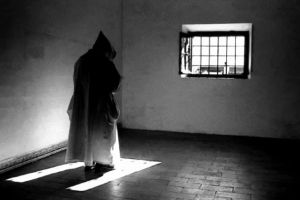
Cell
The Porous Self: Community and Intersubjectivity from the Inner Room
This is the eighth and final post from an 8-week cycle drawing excerpts from my book, The Monk’s Cell: Ritual and Knowledge in American Contemplative Christianity (Oxford University Press, 2018). Gratitude to all at The Contemplative Society for inviting me to participate.
The eighth chapter, Cell, is a narrative of the illness and death of Helen Eberle Daly, one who was dear to many of us in the Wisdom community. Beginning with our pilgrimage together to Assisi, Helen’s story beautifully illustrates how solitude and silence are profoundly communicative acts, and how devoted practitioners have the potential to courageously work towards contemplative maturity regardless of life’s jagged edges.
That first afternoon, Helen and I walked out of the towering eastern gate of the medieval walled town of Assisi and headed toward San Damiano. I was sketchy about the story of Francis, but this much I knew: San Damiano was the little church that Francis had rebuilt from ruins when he first felt the call to a religious life. The story goes that in the rubble of a chapel ruin that was ancient in his own time, Francis was praying before the dilapidated altar when the crucifix hanging above said to him, “Repair my house.” Francis took the imperative literally and restored San Damiano stone by stone, then later turned it into a convent for Clare and the women who followed her.
The cobbled path took Helen and me down a hillside covered in gnarled olive trees. Some were so old that their trunks were nothing more than perforated husks barely capable of supporting their leathery silver-green leaves, so old that some might have been there when Francis himself walked that road 800 years ago. We passed a few trinket stalls, modest stone farmhouses with hand-lettered signs advertising “Olio di oliva in vendita,” a fourteenth-century iron-gated shrine displaying its candlelit fresco of the Madonna and Child, and shiny outdoor escalators rising from a sizable parking lot for some of the many air-conditioned coaches that brought tourists and pilgrims to Assisi every day.
During the forty-minute walk, Helen stopped several times. Her back was really bothering her, she said, probably due to the many hours of wandering around Rome for three days when they first arrived in Italy, after being relatively inactive at home in Vermont during a particularly harsh winter.
Notices requesting “Silenzio per favore— tenere in riverenza” told us we were getting closer. San Damiano appeared around the bend of a curving monastery wall and a line of cypress trees. It was tiny and simple, with a finely worked rose window, terracotta roof tiles, sheltering cloister arches, and a small stone piazza with banks of votive candles. Two bronze statues depicted Francis, one walking barefoot with staff in hand toward the church’s portico and another meditating cross-legged on the hillcrest before an expansive view of the rural landscape below. How different from the magnificent thirteenth-century basilica, adorned by the likes of Giotto, Cimabue, and Martini, that was built later on the other side of town in reverence for (and also in spite of) Francis’s simplicity and radical poverty.
Threading our way through a scrum of photo-snapping visitors and past a young black-bearded friar who was sweeping the outer courtyard’s stone pavements, we entered through a side chapel, which featured a gruesome, life-sized Baroque crucifix, then made our way into the nave of San Damiano proper. Helen and I stopped in our tracks: the sanctuary’s low plaster vault was so organically irregular, the dusky filtered light so pensive, the early medieval starry-night frescoes so intimately drawn, the rickety wooden choir stalls so clearly made by the hands of those who used them centuries ago. The floor tiles were worn glossy from the thousands upon thousands who had stepped through, and the plaster walls were seasoned with the touch of so many who had remained there in prayer. Above the diminutive altar was the painted, iconic Syrian-Christian crucifix that people all around the world, including those in my research, hold in special reverence.
It seemed more than the evocative minimalist charm of early medieval Umbrian aesthetics that moved Helen and me, however. Wide-eyed, I turned to my companion to find her in tears. She was also shaking, then I realized the same was true of me. We stood at length in the middle of the chapel with people moving all around us until we finally eased our way through the throng to a place in the narrow wooden pews. A few of the visitors stayed in the chapel, but more surged by in a steady stream, first looking about, then heading on past the altar for a self-guided tour of the cloister where Clare and her adherents once lived. Meanwhile, my entire body shook, not a little but rather violently. I felt as though I were on fire. I placed my hands and forehead against the cool plaster wall to try to steady myself. This was rather unexpected.
We stayed there a long time, but finally got our bearings. Moving out of the chapel toward Saint Clare’s cloister, I felt some return of composure. We stepped through the nuns’ private brightly frescoed choir, where they would have performed their daily offices and received communion, and climbed narrow, turning stairs to an upper dormitory cell with low slanted ceilings and a wall of arched windows opening onto an enclosed courtyard below. There, sunny geranium-filled balconies had a settling effect on me. But Helen responded differently. One corner of the dormitory was cordoned off with silk rope. On the floor was a ceramic hand-painted plaque telling us that this was the place of Chiara’s (Clare’s) death. Helen’s breath caught. She stopped and knelt there, gazing with bowed head and parted lips.
A group of Bolivian nuns came through, led by a priest who gave them tidbits of history in Spanish. The breach of silence annoyed me, but Helen told me later how moved she was by their devotion. A few of the nuns rubbed their rosaries over the place where Chiara had died, a gesture of sanctification that I saw many times at sacred sites in Assisi. When the black-habited women had moved on, Helen stretched her torso and arms forward until her forehead touched the ground in the Islamic-style posture of half-prone prostration. I went to sit in the window arch and wondered about the severity of sensation that had overtaken me when we first entered the chapel of San Damiano. It wasn’t as if I had a devotion to Francis, or any other saint, for that matter. I knew very little about them. Below in the enclosed cloister garden, tourists milled about a stone well and flower beds. Helen remained some time in prayer.
Both of us left San Damiano feeling a little shattered. We spoke with astonishment about the strange, visceral, and unexpected response. Helen said she deeply felt the presence of Francis and Clare, but that an especially strong sensation of connectedness came over her in Clare’s cell. “It was like Chiara had her arms around me in sanctuary,” she said. “Something big happened here,” said Helen, looking out at the Umbrian plain. “And it’s still happening.”
For those who are interested in purchasing a copy of The Monk’s Cell, you can receive a 30% discount by ordering online at global.oup.com/academic with promotion code AAFLYG6.


Comments