
Benedictine Quantum Spirituality
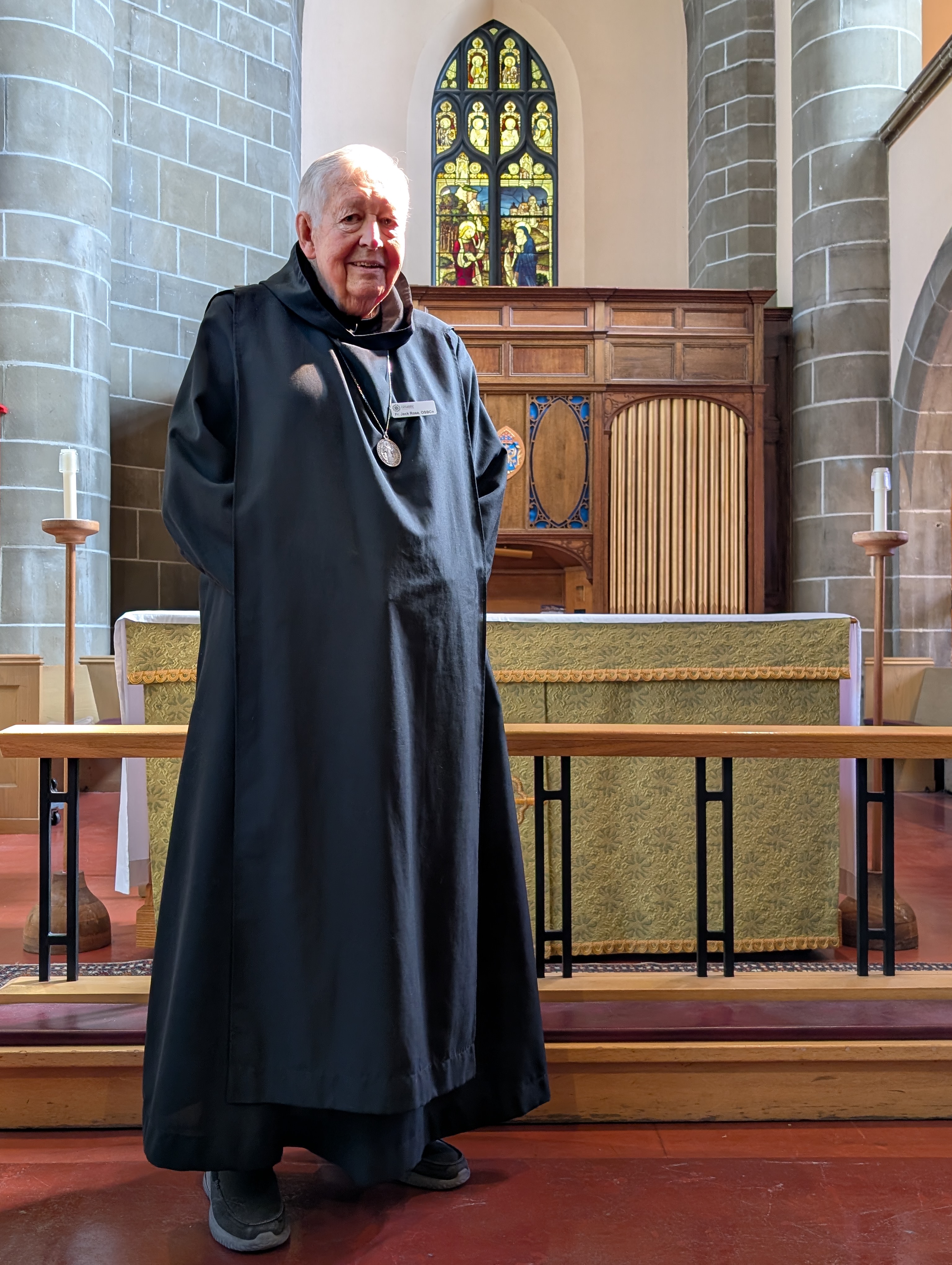
by The Rev. Jack Rose OSBCn

Traditional Benedictine spirituality, and Christian monasticism in general, are rooted in the rule of St. Benedict. The “Rule” has been followed, interpreted and examined by many for almost 1500 years, yet it still exists and thrives. This does not mean it cannot be influenced by the culture in which it resides in present time. The reflections on the influences which follow are the musings of this one Benedictine and may not represent the thoughts of others.
My grandson, a PhD candidate, stated that he believed “the human brain had the capability to solve all the mysteries of the universe, providing it was given the correct information”.
I am neither a neurologist, nor any type of research scientist, but I do know that present day science tells us that we are able to use 100% of our brain and not just 10% as previously believed. (MIT McGovern Institute) How often, and when we access our total brain capacity is another question. However, when we are solving problems, brain scans reveal that nearly all areas of the brain are working together and networks respond according to the task.
So, my grandson’s statement raises this question in my mind. Could this little piece of grey matter, itself part of creation, solve the mystery of creation, and so reveal the Creator?
In Stephen Hawking’s book. A Brief History of Time: He states “If we do discover a complete theory, it would be the ultimate triumph of human reason - for then we would know the mind of God”. To be honest, Hawking was an atheist, and I’m sure he meant if there was a God. (Note: Stephen Hawking’s ashes are buried in the Scientists’ Corner of Westminster Abbey between Sir Isaac Newton and Charles Darwin.)
How is it possible that our minds could ever fully understand the mysteries of the creation and workings of the universe? I am reminded of the story of St. Augustine walking on the beach and struggling with his thesis, De Trinitatis. He encountered a child attempting to pour the ocean into a hole he had scooped on the beach. When he asked the child if he thought he could pour the ocean into that tiny hole, the child replied, “do you think you can fit God into your head?”
It seems obvious that we cannot retain enough information to “discover a complete theory” or to “fit God into (our) head”. However, the question does not end here. Although the rule of Benedict does not specifically refer to the creation of the universe, one of the most notable visions of Benedict was recorded by St. Gregory in his Dialogues: “He famously experienced all of creation as a single, unified reality held together by God's light.” Benedict’s unity with God was so strong that he saw the whole of creation through God’s eyes.
In Benedict’s vision, there is a unity between the physical and spiritual world which is compressed from the macro to the micro in a moment of time.
French theologian, Pierre Teilhard de Chardin, saw the universe as “interconnected and evolving, an entanglement of the external physical world and our spiritual awareness”. Like Benedict’s vision, de Chardin sees all of this physical and spiritual world being reduced to its smallest form and connected in the mind of the Creator.
Perhaps it helps us to know that quantum physics is “the study of matter and energy at the most tiny, microscopic scale. At this level, standard rules of big objects do not work. Energy and light come in tiny packets”. Perhaps it also true that we cannot apply the standard rules of overt spiritual awareness to smallest, the tiniest “submicroscopic” moments of our awareness of the spiritual world. They may be far more plentiful than we realize. In fact, they may be constantly present in what German theologian Paul Tillich describes as the “eternal now”.
My gym friend Tom, a physicist, worked with the Large Hadron Collider in Cern, Switzerland. The LHC is the world’s largest and most powerful particle accelerator. He explained that “the LHC can split an atom into subatomic particles they called the Higgs boson” (God particle). Further studies have shown they are identical and could appear to be in two places at the same time. They are aware of changes or influences on one another and change accordingly. This occurs regardless of distance. They also fill the entire universe but cannot be seen. It seems to me all this interconnectedness is almost spiritual.
The Higgs bosun field, as submicroscopic as it is, floods the entire universe and slows down other particles to give them mass and, therefore, visibility. De Chardin suggested that matter is simply “spirit moving slowly enough to be seen”. This appears to be his attempt to view a universe that contains the external physical world and an internal awareness of, and interconnectedness with, the Creator.
Quantum physics helps us to understand that Benedictine spirituality is filled with this interconnectedness:
The Rule expresses the unity of all creation, notably Chapter 32 demanding our care for all things, and the psalms of the daily offices; e.g. psalm 104.
Benedictines do not view God as distant but believe that the spiritual interpenetrates reality which creates a communal empathy among all living things.
Deep listening to the Creator with the “ear of the heart” is the beginning of the Prologue to the Rule. This meditative practice exposes us to a non-material dimension of reality, where we hear and feel the divine presence.
Benedictines feel a community interconnectedness rooted in the daily rhythms of physical stability and work, either manual or intellectual, and prayer or meditation. This echoes the rhythm of the universe. Science tells us that quantum particles affect each other across vast distances which creates oneness. There is also a spiritual unity which defies physical separation.
Meditative practices like lectio divina, audio divina and visio divina create an openness to receive those invisible but powerfully present glimpses of God in our lives. Benedictines share this with all faiths as we journey together towards the Creator with the cosmic energy of love.
The Rule, in almost every chapter, reminds us that the Creator is in everyone, we encounter; guests, the sick, travellers, rich and poor and those of other faiths and belief systems.
To return to our original question of revealing the Creator; there is no need to “fit God into our head”. The Creator is already here, within us, waiting to be discovered in the glimpses, both macro and micro we experience.
The Higgs bosun fills the known physical universe, which is already here, waiting to reveal more and more of the wonderful secrets of its creation. Similarly, our glimpses of the spiritual realm reveal more and more of the mysteries of the omnipresence of God. Holy scripture, as important as it may be, is not the end of the revelation of the Creator.
Benedictine quantum spirituality is a reaction to the influence of quantum physics that brings Christian monasticism and, notably, the Rule of Benedict, into today’s world. Does this bring us closer to the “ultimate triumph of knowing the mind of God”? Perhaps, in glimpses, mostly micro, that wash over us every day, but the mind of God is quite simply beyond our imagination.
“For now we see in a mirror, dimly, but then face to face. Now I know in part; then I shall know fully, even as I have been fully known.” (1Cor. 13-12)

The Rev. Jack Rose OSBCn
Fr. Jack is a life professed member of the Benedictine Canon community of St. Aidan, an honouary priest associate of Christ Church Cathedral, Victoria BC, a retired educator and a Royal Canadian Air Force veteran.


Comments